What Is Agentic Event Management?
 Tom
5 min read
Tom
5 min read
What is agentic event management?
Agentic event management is an approach to event operations where AI agents autonomously handle repetitive tasks — attendee list imports, post-event reports, email sends, badge generation, and check-in monitoring — without human intervention for each step.
Unlike traditional event management software that gives you dashboards and tools to do the work yourself, an agentic event platform assigns specific operational tasks to purpose-built agents. Each agent handles one part of the event lifecycle, runs independently, and delivers completed work.
The distinction matters: traditional platforms automate workflows (you still configure, trigger, and monitor). Agentic platforms delegate work (the agent handles it end-to-end, you review the output).
How agentic event management works
An agentic event platform deploys specialized agents, each responsible for a discrete operational task:
Import Agent takes a raw attendee CSV — with duplicates, missing emails, inconsistent name formatting — and delivers a clean, deduplicated list ready for use. What used to take two hours of spreadsheet work happens in seconds.
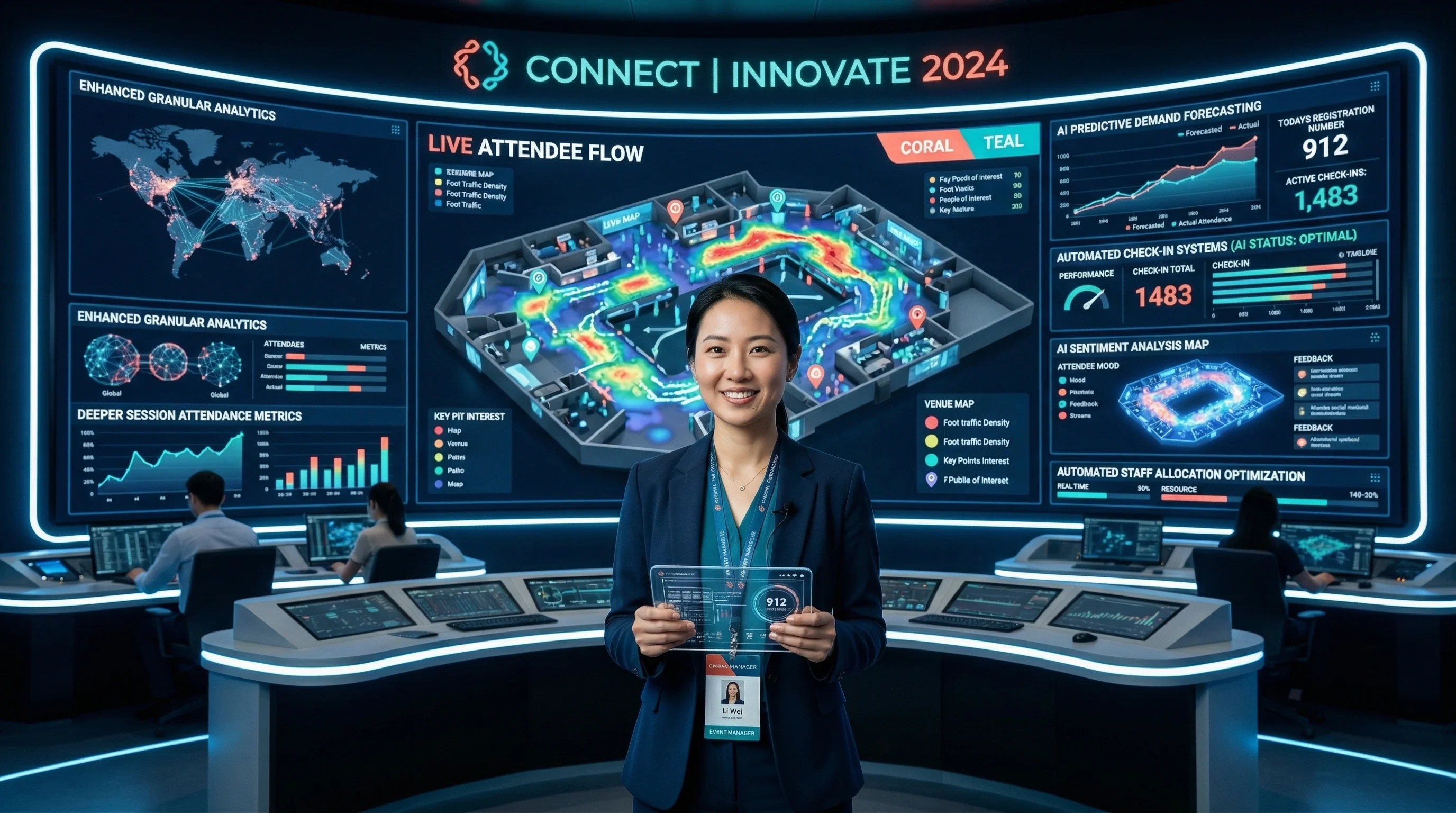
Report Agent compiles post-event data automatically: attendance rates, session popularity, no-show analysis, peak check-in times. The report is ready before you leave the venue, not two days later after someone pulls numbers into a deck.
Email Agent sends confirmation emails, reminder blasts, and post-event thank-yous. It handles bounces and retries without anyone writing a follow-up.
Badge Agent generates badges from your template — hundreds or thousands — sorted, print-ready, and delivered before the event. Last-minute additions and walk-in badges are handled on demand.
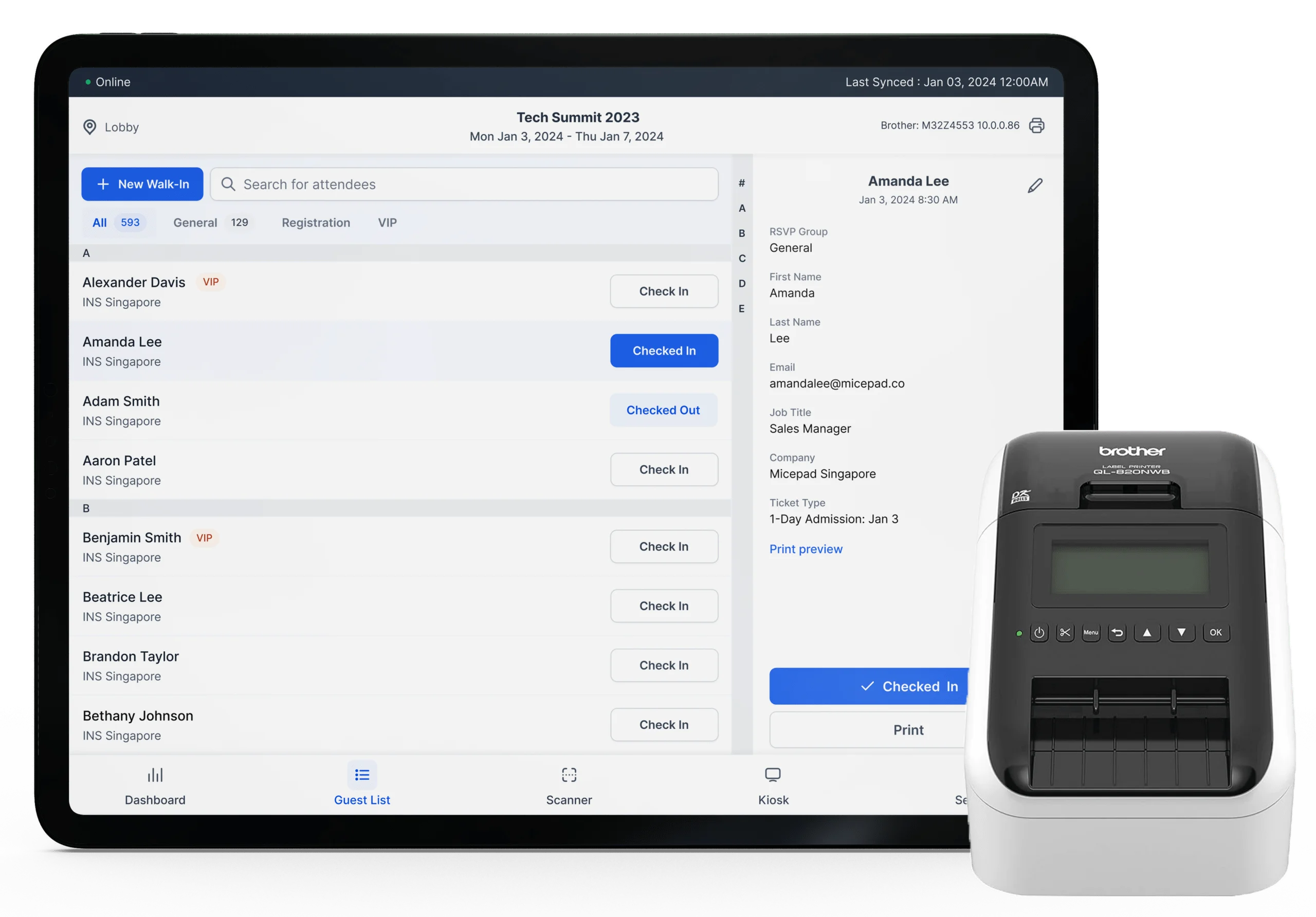
Check-in Agent monitors every entrance in real time. Capacity alerts fire before rooms fill up. Session tracking runs across venues. Live attendance data flows without anyone watching a dashboard.
Gamification Agent queries engagement scores, leaderboards, and session participation — delivering instant insights instead of requiring manual counting.
What agentic event management is not
It is important to be specific about what agents handle and what they do not.
Agents handle the data and operations layer: importing, cleaning, generating, sending, monitoring, and reporting. These are high-volume, repetitive tasks that follow predictable patterns.
Agents do not handle the creative and relational layer: badge design, event setup and configuration, speaker management, sponsor relationships, venue logistics, or registration form design. These require human judgment, creativity, and interpersonal skills.
This is not a limitation. It is the point. The operational grind is not where event teams add value. Agents take it off their plate so they can focus on the work that actually requires a human — making sure the room feels right, the speakers are prepared, and the sponsors are happy.
Why it matters for event agencies
Event agencies feel the impact most. A team of 10 running 20 events a year generates the same pile of operational work for every single event: import the list, clean the data, send the confirmations, print the badges, pull the report. Multiply that across clients and events, and a significant portion of billable hours goes to data processing rather than event management.
Agentic event management changes the unit economics. The same team that runs 15 events this year can run 30 next year, because the hours spent on data processing per event drop dramatically. That is not a productivity hack — it is a margin structure change.
It also addresses burnout. Event teams are chronically overstretched. The midnight CSV cleanup, the post-event report deadline, the bounced email chase — these are the tasks that burn people out. When agents handle them, the team's energy goes to the work they were hired to do.
How it compares to traditional event software
Traditional event management platforms — Cvent, Bizzabo, Whova, and others — provide tools, dashboards, and workflows. They are powerful infrastructure. But they all share one assumption: a human operates the system.
You configure the badge template. You trigger the email send. You export the attendance data. You build the post-event report. The platform provides the capability; you provide the labor.
Agentic event management inverts this. The platform provides both the capability and the labor. You provide the oversight.
| Traditional platform | Agentic platform | |
|---|---|---|
| Attendee import | Upload CSV, manually fix errors | Agent imports, cleans, and deduplicates automatically |
| Badge generation | Configure template, trigger batch print | Agent generates from template, delivers print-ready files |
| Email sends | Set up campaign, schedule, monitor | Agent sends, handles bounces and retries |
| Post-event report | Export data, build in spreadsheet/slides | Agent compiles and delivers report |
| Check-in monitoring | Watch dashboard, respond to alerts | Agent monitors and alerts proactively |
The delegation frame
The event industry already runs on delegation. Event managers delegate to coordinators, coordinators delegate to assistants, teams delegate to vendors and AV crews. An agent is the next role on the team — except it scales across every event simultaneously.
Event managers. Event coordinators. Event assistants. Event agents.
The progression was always obvious.
Getting started with agentic event management
Micepad is the first event platform built around agents. It has served over 500,000 attendees since 2013 across check-in, badge printing, registration, and the event app, for organizations including MongoDB, Standard Chartered, KPMG, and WeWork across Singapore, Hong Kong, and Taiwan.
The agentic layer is available through Micepad's platform and through micepad-cli, a command-line tool that exposes every agent as a command. Teams with developers can orchestrate event workflows programmatically or connect agents to AI assistants like Claude or ChatGPT. Teams without developers use the platform directly — the agents run in the background.
Curious about agentic event ops?
Micepad is the first event platform with AI agents — let's show you what they do.