Event Management Software HK: Best Platforms (2026)
 Tom
16 min read
Tom
16 min read
Executing a B2B summit at the Hong Kong Convention and Exhibition Centre (HKCEC / 會展) in Wan Chai, an international trade fair at AsiaWorld-Expo (亞洲國際博覽館), or an executive banquet at Kowloonbay International Trade & Exhibition Centre (KITEC) requires flawless operational timing. Hong Kong delegates, international buyers, and Greater Bay Area (GBA) cross-border executives expect a frictionless digital experience from the second they land on your event website to the moment they collect their physical badge.
Yet many event teams in Hong Kong still rely on fragmented tools: handling English sign-ups on one platform, sending Traditional Chinese confirmations manually, processing local payments through disconnected merchant accounts, and enduring chaotic queue bottlenecks at the registration counter.
Adopting a specialised event management software solution eliminates these operational points of failure. By consolidating bilingual registration forms (網上報名系統), instant local payment processing, automated confirmation messages, rapid door check-in, and instant badge printing into one central workflow, event planners can safeguard data integrity and elevate the attendee experience.
This guide evaluates how an event registration platform operates, what Hong Kong planners must prioritise — from Personal Data (Privacy) Ordinance (PDPO) compliance to FPS (轉數快) payment integration — and how the top event registration software options compare in 2026.
What is an Event Registration System?
An event registration system (活動報名系統) is an integrated digital platform that automates attendee sign-up, ticket payment, credential issuance, and event check-in. In the corporate event technology industry, terms such as event registration software, event management software, and attendee registration system are used interchangeably. The primary objective remains the same: capture delegate data accurately while delivering a seamless, professional experience.
Simple form builders can collect names. A dedicated event registration platform connects pre-event marketing directly to physical venue operations. It turns raw registration lists into real-time operational control, so door staff can authenticate guests in seconds while organizers monitor live attendance.
Core Functions of a Complete System
A modern online event registration solution powers the full event lifecycle by replacing spreadsheets and disconnected tools with a cloud-connected infrastructure. Whether you are managing a 200-person C-suite seminar or a multi-day conference with 5,000 delegates, an enterprise-grade event management system (活動管理系統) unifies six operational modules.
1. Customisable bilingual forms and dynamic logic
In Hong Kong's international business environment, an attendee registration system must serve a multilingual audience. Dynamic form builders let organizers create sign-up pages that toggle between English and Traditional Chinese (繁體中文). Advanced platforms support conditional logic — showing customized questions, VIP session tracks, or restricted ticket passes based on delegate category (Media, Speaker, Sponsor, General Delegate).
2. Ticketing and multi-currency payment processing
As specialized event ticketing software, the platform manages Early Bird rates, group passes, VIP invitations, and promotional codes. To streamline event registration and payment, it handles multi-currency transactions via payment gateways — Visa, MasterCard, Amex, Stripe, and local Hong Kong methods such as FPS (轉數快), PayMe, Alipay HK, and WeChat Pay HK — and issues official business receipts at checkout.
3. Automated confirmations and attendee communications
Upon registration, the system dispatches personalized, multilingual confirmation emails and calendar invites (.ics). Organizers can segment lists, push reminder notifications, distribute venue entry passes with unique QR barcodes, and send last-minute schedule updates.
4. Event registration with QR code check-in
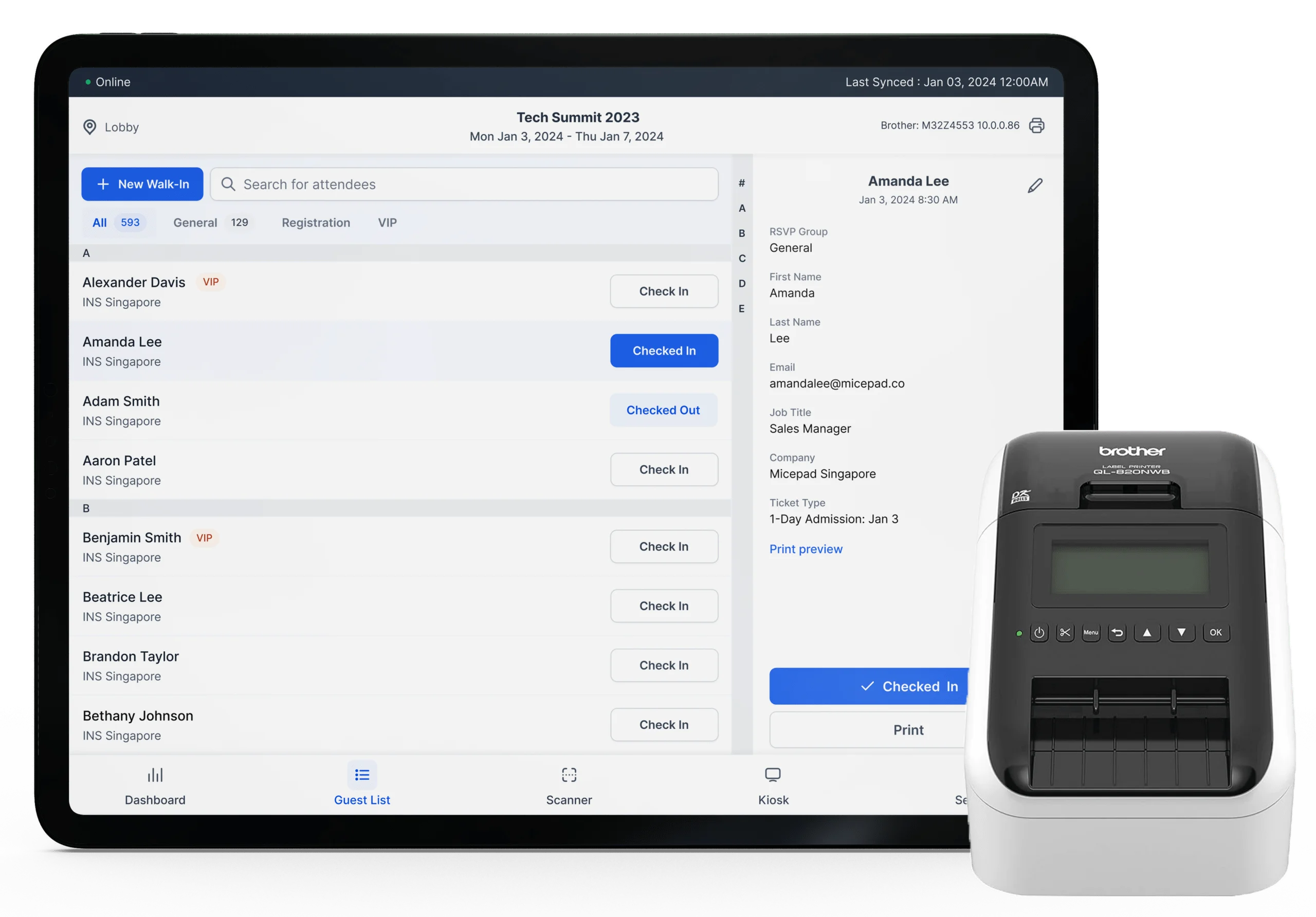
Entry bottlenecks at venue doors create immediate delegate frustration. A modern conference registration system equips front-of-house staff with high-speed tablet scanning apps. Door staff scan digital QR codes from smartphones, authenticate credentials, and update attendance records in under three seconds per guest. See our event check-in solutions for Hong Kong conferences and best event check-in apps.
5. On-demand badge printing and self-service kiosks
An advanced Hong Kong setup links directly with on-site thermal badge printers (Zebra or Brother). When a guest scans their QR code at a kiosk or check-in desk, the software prints a custom badge with name, company, and designation — including Chinese character typesetting. This cuts setup labor, eliminates badge waste, and handles walk-ins. Related: badge printing for corporate events in Hong Kong.
6. Real-time data analytics and attendance reporting
A complete event management software suite includes a dashboard for registration velocity, revenue, session conversion, and live hall occupancy. Organizers can track peak arrivals and session popularity from a mobile device, then share post-event lead intelligence with sponsors.
What to Look for in an Event Registration Platform (Hong Kong Context)
International vendors offer generic ticketing features. Running events in Hong Kong demands local capabilities. Prioritise these seven criteria.
1. Bilingual support (English and Traditional Chinese 繁體中文)
Hong Kong is a bilingual corporate market. Global software built only for English often breaks when rendering Chinese typography on badges or in confirmation emails. Your software should offer:
- Native language toggling on public registration forms and landing pages
- Multilingual email confirmation templates (EN / 繁體中文)
- Unicode-compliant badge printing that renders Chinese characters alongside English names without font distortion or line-break errors
2. Data privacy compliance (Hong Kong PDPO and PCPD guidelines)
Attendee personal data — names, mobile numbers, corporate emails, and passport/HKID details — falls under Hong Kong's Personal Data (Privacy) Ordinance (PDPO), enforced by the Privacy Commissioner for Personal Data (PCPD). Ensure the platform provides:
- Explicit, un-pre-ticked opt-in consent checkboxes for data collection and marketing
- Clear privacy policy disclaimers compliant with PDPO Personal Information Collection Statement (PICS) requirements
- Role-based access controls so contractors or temporary staff only see necessary operational data
- End-to-end encryption in transit and at rest, plus data deletion protocols after the event
3. HK local payment methods and official invoicing
Global delegates prefer credit cards. Local Hong Kong attendees, SMEs, and mainland cross-border guests expect more flexible options:
- Faster Payment System (FPS / 轉數快): instant bank-to-bank HKD transfers without card markups
- PayMe by HSBC and mobile wallets: PayMe, Alipay HK, and WeChat Pay HK
- No-GST invoicing: Hong Kong has no GST or VAT. The software should produce clean, tax-neutral official receipts and corporate invoice numbers for finance audit trails
4. Rapid QR code check-in and hardware integration
High-density events at HKCEC or AsiaWorld-Expo cannot afford slow entry. Choose a QR check-in solution that authenticates in under 3 seconds per person, with native support for tablet stands, handheld Bluetooth scanners, and direct-thermal badge printers.
5. Offline resilience for venue network drops
Exhibition centres with heavy concrete walls and thousands of active devices frequently drop wireless. A reliable attendee registration system must cache a local database. If Wi-Fi fails, check-in and badge printing continue locally, then sync when connectivity returns.
6. Local HKT timezone and on-site technical support
When an issue arises at 7:30 AM HKT during morning desk setup, waiting for a European or North American support desk is unacceptable. Choose vendors with dedicated Hong Kong/APAC support who can assist remotely in real time or deploy on-site technical staff.
7. Native integrations with enterprise CRMs
Attendee data must flow into sales and marketing systems. The platform should integrate with Salesforce, HubSpot, and Marketo:
- Map registered attendees into CRM lead pipelines
- Update lead scores when a delegate checks in
- Trigger post-event nurture campaigns based on session attendance
How to Choose the Right Platform for Your Event
Match platform capabilities to your event format, scale, and delegate profile.
| Event format | Primary operational challenge | Recommended platform approach |
|---|---|---|
| B2B conferences and summits | Multi-track agendas, bilingual badge printing, corporate invoicing, fast door check-in | Enterprise platform with native EN/繁中 support and hardware integration |
| Executive seminars and roundtables | Fast registration setup, strict PDPO compliance, executive user experience | Lightweight software with flat per-event rates and custom form logic |
| Trade shows and B2B expos | High-volume scanning, self-service kiosk clusters, offline sync, exhibitor lead capture | High-throughput system with offline caching and multi-kiosk printer arrays |
| Public ticketed events | Mass consumer reach, simple checkout, social sharing, consumer payment options | Public event marketplace with integrated consumer promotion |
Best Event Registration Platforms in Hong Kong (2026)
We compared leading global, regional, and local Hong Kong event platforms on registration, bilingual support, and on-site operations.
Comparison overview
| Platform | Best for | Pricing model | QR check-in | On-demand badge printing | Bilingual (EN / 繁體中文) | Free tier |
|---|---|---|---|---|---|---|
| Micepad | Regional B2B conferences and corporate events | Public per-event rates (from USD $475) or annual plans | Yes (<3s scan) | Yes (thermal sync) | Native full support | Yes (up to 50 pax) |
| EventX | GBA cross-border trade shows and virtual/hybrid events | Subscription tiers / custom quotes | Yes | Yes | Native full support | Free trial / demo |
| GEVME | Enterprise and public sector summits | Annual admin license (USD $1,050+/yr) + tier fees | Yes | Yes | Supported (custom forms) | Yes (limited features) |
| Cvent | Global enterprise and multi-national events | Custom quote | Yes | Yes | Supported (configuration required) | No |
| Whova | Academic conferences and mobile-app-heavy events | Per-ticket or custom quotes | Yes | Yes | Limited (app-centric) | No |
| Eventbrite | Public consumer, social, and community gatherings | Per-ticket fees + processing | Yes (basic app) | No | Partial (form text only) | Free for non-paid events |
| Bizzabo | Large-scale global B2B conferences | Custom annual enterprise quote | Yes | Yes | Supported (multi-lingual module) | No |
Detailed vendor mini-reviews
1. Micepad
Micepad Hong Kong is an APAC-focused event management software built for corporate organizers, conference producers, and enterprise marketing teams across Hong Kong, the United States, and Southeast Asia. It bridges digital online registration with high-speed physical venue execution.
Key strengths:
- Native bilingual (English and Traditional Chinese) registration forms, confirmation communications, and Unicode badge printing
- Transparent pricing with a permanent free tier for up to 50 attendees, plus flat per-event packages for budget predictability
- On-site check-in with sub-3-second QR scanning, automated thermal badge printing, self-service kiosks, and offline caching
- PDPO-aligned privacy controls and dedicated HKT-timezone support
Genuine limitation: Micepad is engineered for professional B2B conferences, corporate meetings, and trade events. It is not a public ticket discovery marketplace for consumer entertainment.
2. EventX (formerly EventXtra)
EventX is a Hong Kong-founded provider of registration, ticketing, and virtual event capabilities for Greater Bay Area (GBA) cross-border events.
Key strengths:
- Deep local presence in Hong Kong and familiarity with corporate and trade show requirements
- Native bilingual interface for Traditional Chinese and English workflows and badge printing
- Payment gateways supporting local Asian methods alongside standard card processors
Genuine limitation: Advanced features — full on-site hardware rentals, dedicated technical manpower, and custom WhatsApp notification modules — are typically restricted to high-tier enterprise plans.
3. GEVME
GEVME is a Singapore-headquartered enterprise platform used across APAC, including Hong Kong public sector and corporate events.
Key strengths:
- Highly customizable registration architecture for multi-day conventions and government summits
- Suite covering landing page builders, business matching, and attendee management
- Strong regional reputation for large-scale enterprise data requirements
Genuine limitation: Pricing relies primarily on annual subscription contracts, which can be a high commitment for teams running occasional events.
4. Cvent
Cvent is the global enterprise standard, serving Fortune 500 corporations and event agencies worldwide.
Key strengths:
- Feature depth covering venue sourcing, complex multi-track registration, budgeting, and CRM integration
- Multi-event portfolio management and analytics for enterprise marketing teams
Genuine limitation: High cost of entry. Cvent uses custom quotes (often with per-registrant fees), which is often prohibitive for small-to-midsize Hong Kong corporate events.
5. Whova
Whova is a US-developed platform designed primarily for academic conferences, association conventions, and trade expos that need heavy mobile app engagement.
Key strengths:
- Strong mobile event app with networking, discussion boards, and interactive agendas
- Combined online registration, attendee communication, and badge template generation
Genuine limitation: No dedicated local technical support on the ground in Hong Kong. Organizers typically manage hardware rentals independently and rely on overseas support during peak HKT hours.
6. Eventbrite
Eventbrite is a public ticketing marketplace, best suited for consumer workshops, public entertainment, and community networking events.
Key strengths:
- Built-in consumer search directory that drives organic ticket discovery
- Simple self-serve dashboard to publish a basic ticket page quickly
Genuine limitation: Lacks dedicated B2B conference tools such as bilingual Chinese/English badge printing, offline hardware printer sync, and PDPO-tailored corporate data controls.
7. Bizzabo
Bizzabo is an enterprise event experience OS designed for large B2B technology conferences and brand summits.
Key strengths:
- Website creation tools, mobile event app modules, and marketing automation
- Analytics across physical and digital touchpoints
Genuine limitation: High-tier annual enterprise contracts, so it is unviable for organizers who want self-service, pay-per-event pricing.
Onsite Execution and Hardware Architecture for Hong Kong Venues
Deploying software online is only half the battle. Physical execution at HKCEC in Wan Chai, AsiaWorld-Expo in Chek Lap Kok, or hotel ballrooms in Central determines the first impression. A failure at the registration desk creates morning bottlenecks that delay keynotes.
Hardware deployment and kiosk configurations
To process heavy morning arrivals (typically 8:15 AM to 9:15 AM HKT), high-density corporate summits use a hybrid model of self-service kiosks and manned counters:
- Self-service check-in kiosks: iPads on floor stands. Delegates scan the QR code from their confirmation email or search by name.
- Direct-thermal printers: terminals connect via wireless LAN or Bluetooth to industrial thermal printers (Zebra or Brother). Thermal printing needs no ink ribbons or toner, reducing smudging and jams.
- Bilingual badge types: choose stock that matches the format — adhesive labels or double-sided tear-resistant butterfly cardstock that displays English names and Traditional Chinese characters clearly.
Network resilience and venue Wi-Fi strategy
High-density halls congest when thousands of attendees connect at once. If your registration system depends on continuous cloud access, a network drop will halt scanning.
Use offline-first architecture. Complete registration records live locally on entry tablets. Scans, badge printing, and walk-ins run on an encrypted local network (LAN), then sync to the cloud when internet returns.
Pricing and Fees: What Event Registration Really Costs
Look beyond the base subscription. Total cost of ownership depends on pricing model, payment processing, and hardware.
Primary pricing models
- Per-ticket commission + processing fee: common on consumer platforms (for example Eventbrite). Cost-effective for small paid workshops, but fees escalate on high-value B2B passes.
- Pay-per-event flat rates: preferred by B2B platforms like Micepad (from USD $475/event). Organizers pay a flat fee based on attendee caps (250, 500, or 1,000 guests) regardless of ticket price.
- Annual platform subscriptions: Cvent uses custom quotes. Other enterprise systems (GEVME, Bizzabo) typically use annual contracts, often plus per-registrant fees. This suits organizations running many events annually.
See Micepad pricing for current public rates.
Secondary operational expenses
- Merchant gateway transaction fees: typically 2.0% to 3.4% per online payment
- On-site hardware rentals: wireless badge printers, scanners, and iPad stands
- Badge consumables: thermal cardstock, lanyards, clips
- On-site support specialists for morning peak hours
Step-by-Step Implementation Timeline
Follow this 8-week timeline to launch a conference registration system for a Hong Kong event.
| Timeline phase | Key operational deliverables |
|---|---|
| Weeks 8–6: platform setup and form design | Select software and build branded landing pages. Create bilingual forms (EN / 繁體中文) and review fields against PDPO. Set ticket tiers and connect payment gateways (FPS, credit card). |
| Weeks 5–3: payment and communication testing | Run end-to-end transaction tests. Design badge layouts with correct English and Chinese font hierarchy. Configure confirmation emails with calendar invites and unique QR codes. |
| Weeks 2–1: hardware staging and offline dry run | Finalize rentals (iPads, kiosks, thermal printers, badge stock). Cache registration data onto entry tablets and run an offline check-in test. Train FOH staff on scanning, walk-ins, and name updates. |
| Event day: on-site execution and data sync | Deploy desks 90 minutes before doors open and verify local network. Monitor live arrival velocity and adjust staffing. Export attendance records immediately after for CRM sync and sponsor reporting. |
What You Should Know More About
What is an event registration system?
An event registration system automates online delegate signups, ticket payments, confirmation credentials, and on-site check-in and badge printing.
How much does event registration software cost in Hong Kong?
Free plans exist for small events under 50 attendees. Flat pay-per-event pricing starts around USD $475 for corporate functions. Per-ticket commission models charge roughly 2%–3.7% plus a flat fee. Enterprise platforms such as Cvent require a custom quote.
Is there free event registration software?
Yes. Micepad provides a permanent free tier for events up to 50 attendees with QR check-in. Public ticketing tools like Eventbrite are also free for unpaid public events.
Can I collect payment and register attendees in one system?
Yes. Modern systems integrate with Stripe and local Hong Kong methods (FPS, PayMe, Alipay HK, and credit cards) so delegates complete questions and pay in one workflow.
Does the software support bilingual (English + Traditional Chinese) registration?
Professional Hong Kong platforms offer native multilingual support so delegates can toggle between English and Traditional Chinese (繁體中文) on landing pages, confirmation emails, and badge layouts.
Is event registration software PDPO compliant in Hong Kong?
Leading local providers design platforms to meet PDPO, with explicit un-pre-ticked consent, role-based access, encryption, and transparent retention policies.
Finding the Right System for Your Next Hong Kong Event
For open consumer gatherings, Eventbrite provides discovery reach. For multinational enterprises managing large global portfolios, Cvent delivers extensive administration.
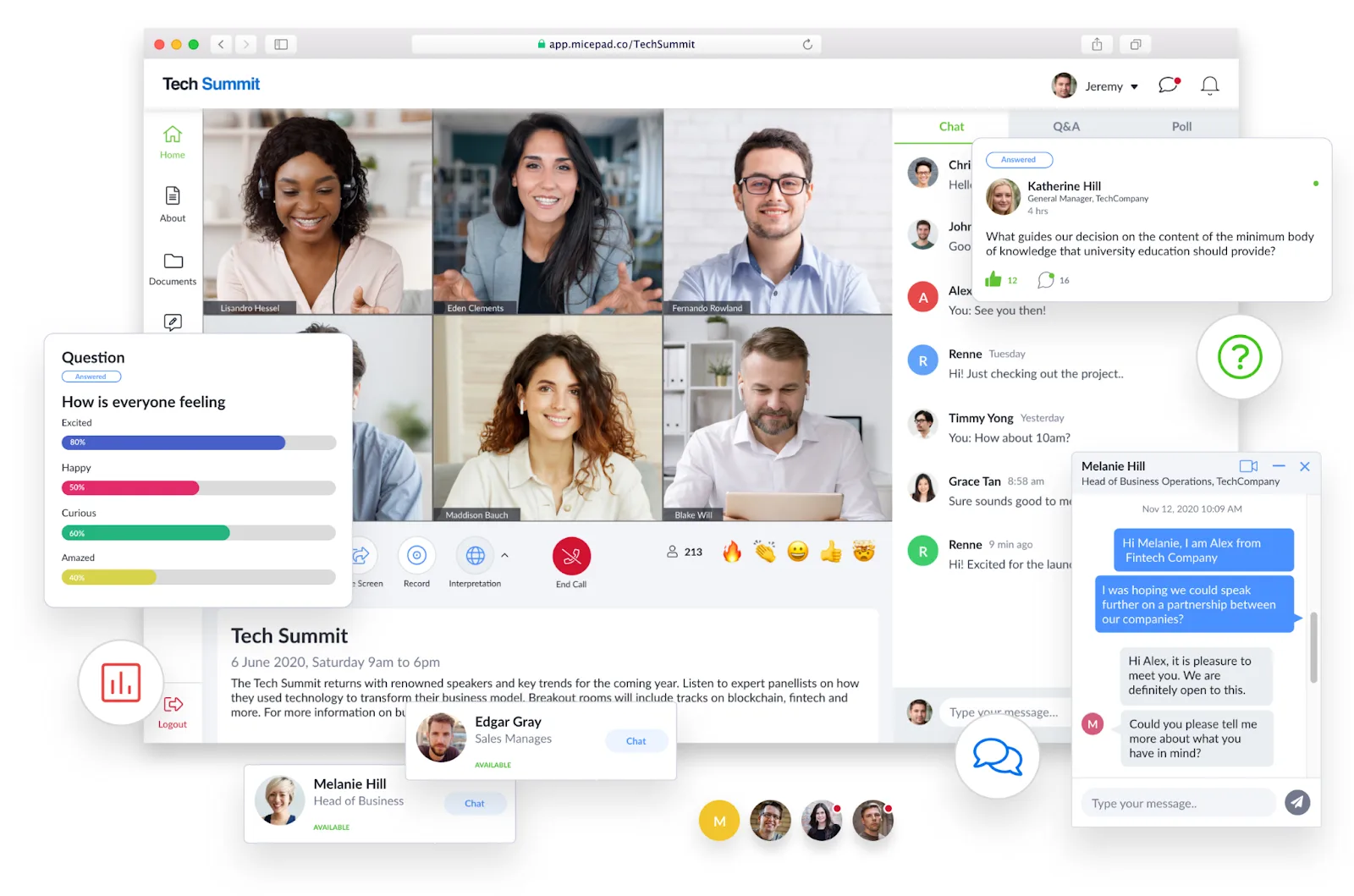
For corporate organizers, B2B conference producers, and enterprise marketing teams in Hong Kong, Micepad is the stronger fit: native bilingual support (English and Traditional Chinese), PDPO alignment, sub-3-second QR check-in, on-demand thermal badge printing, transparent per-event pricing, and HKT-timezone technical support.
Ready to streamline operations? Start your first event for free with Micepad — up to 50 attendees, no credit card required. Or talk to the team about a Hong Kong conference deployment.
See the app at a real event
Read how MongoDB used Micepad's app across 10 APAC cities — 15,000+ attendees.