Event Check-in Solutions for Hong Kong Conferences
 Tom
5 min read
Tom
5 min read
If you have run an event at the Hong Kong Convention and Exhibition Centre, you know the drill. Hundreds of attendees arriving within a 30-minute window. A registration desk that needs to handle English names, Traditional Chinese names, and sometimes both on the same badge. VIP guests from major banks who expect zero waiting time. And a venue layout where a bottleneck at check-in ripples into delayed sessions and frustrated sponsors.
Hong Kong conferences have specific operational challenges that generic check-in processes cannot handle well. Here is what makes them different, and what actually works.
The density problem
HKCEC halls regularly host events with 1,000 to 5,000 attendees. AsiaWorld-Expo handles even larger scale. The common pattern in Hong Kong is a concentrated arrival window, often just 20 to 30 minutes before the keynote. Unlike events in cities with more spread-out schedules, Hong Kong attendees tend to arrive precisely on time.
This means your check-in system needs to process people fast. Paper lists and manual lookup do not scale. Even basic QR code scanning falls short if your printing queue creates a secondary bottleneck.
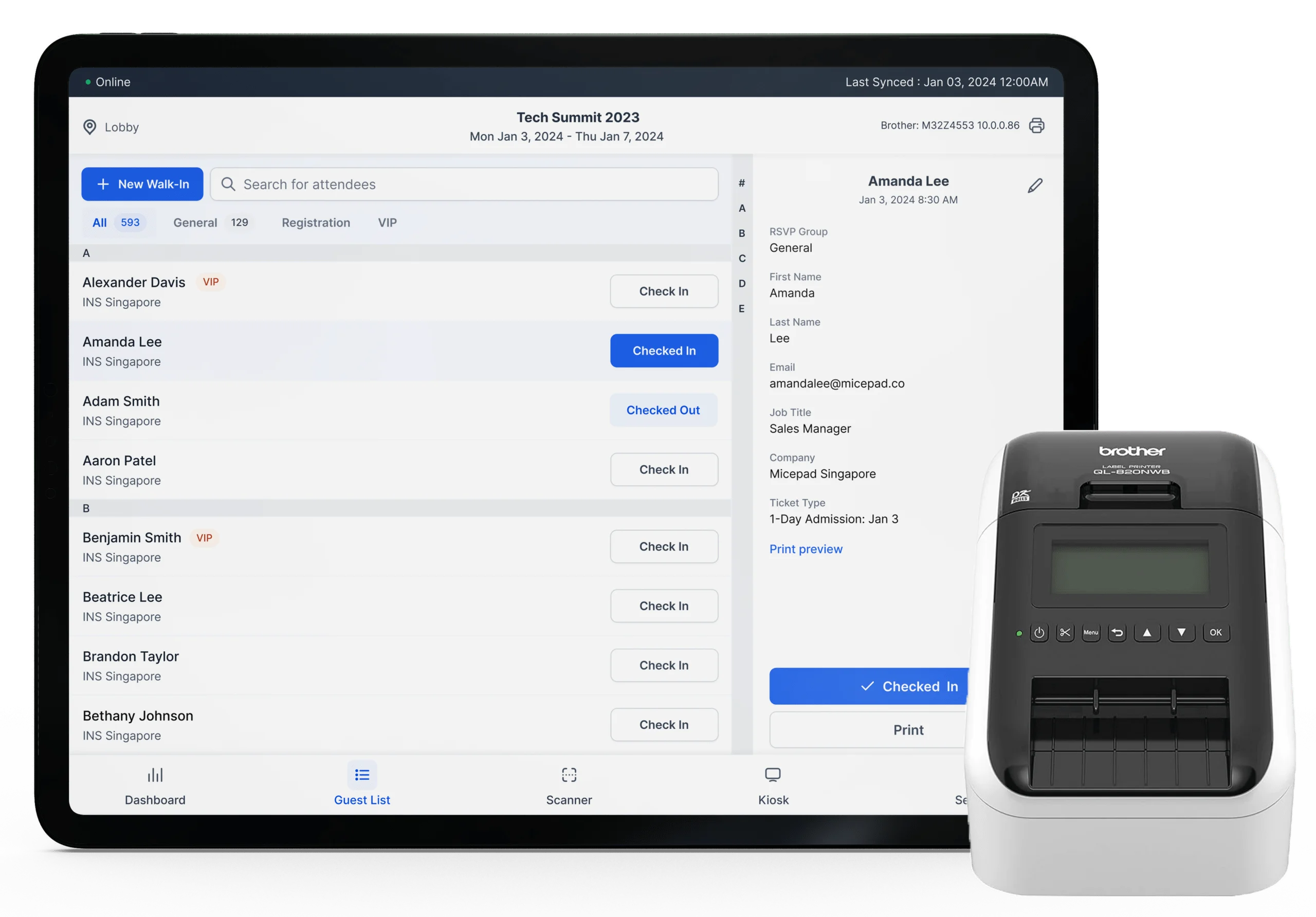
The numbers are straightforward. If 800 people arrive in 25 minutes, you need to process roughly 32 people per minute. With manual check-in, each registration takes 45 to 90 seconds. You would need 24 to 48 staff just to keep pace. With self-service kiosk check-in and on-demand badge printing, each station handles one attendee every 8 to 12 seconds. Six stations can clear the same crowd.
Bilingual badge handling
This is where Hong Kong events diverge sharply from events in other markets. Most corporate conferences in the city need badges printed in both English and Traditional Chinese. That sounds simple until you account for the variations.
Some attendees register with an English name only. Others use Chinese characters. Many need both, with the English name in one size and the Chinese name in another. Company names follow the same pattern. Standard Chartered is straightforward. But many local firms have long Chinese company names that need careful formatting to fit a badge layout without truncating.
A good check-in system lets you define badge templates that handle these variations automatically. The system detects which fields are populated and adjusts the layout. No manual intervention, no last-minute reformatting at the print station.
VIP and tiered access
Hong Kong's position as a financial hub means corporate events here often have strict access tiers. A banking conference might have regulators, C-suite executives, media, and general attendees, each with different access levels, different badge colours, and different entry points.
At venues like the Kerry Hotel or the Grand Hyatt, where space is more intimate, getting VIP routing wrong is immediately visible. A managing director from a major client should not be queuing behind 200 general attendees.
Effective check-in technology handles this with pre-assigned badge categories and dedicated VIP lanes. When a VIP scans their QR code, the system routes them to a specific printer that outputs a distinct badge design. No one needs to manually sort guests. The system does it.
What has changed with AI-driven operations
The latest shift in event check-in is not just faster scanning. It is the move toward agentic systems that handle operational decisions automatically.
For example, Micepad's platform now uses AI agents to manage real-time check-in logistics. If one check-in station is processing slower than others, the system redistributes the queue. If a VIP arrives and all VIP stations are occupied, the agent can temporarily convert a general station. If walk-in registrations spike, the system adjusts badge templates and printer allocation without a human operator intervening.
This matters in Hong Kong specifically because events here tend to have lean operations teams. Organisers work with tight budgets relative to the scale of events they run. Having an AI agent handle the micro-decisions during peak check-in means fewer staff, fewer errors, and a smoother experience for attendees.
On-site realities
A few practical points specific to Hong Kong venues.
Internet reliability. HKCEC and AsiaWorld-Expo have solid Wi-Fi infrastructure, but large events can saturate it. Any check-in system you use should work with local caching so that badge printing continues even if the connection drops temporarily.
Power and space. Venue costs in Hong Kong are high. Every square metre of registration space costs money. Compact kiosk setups that combine a tablet, scanner, and printer in a small footprint save both space and rental costs.
Speed of setup. Many Hong Kong events are single-day affairs. You arrive at 7am, set up, run the event, and tear down by 6pm. Your check-in system needs to be operational within 15 minutes, not an hour.
Choosing the right solution
When evaluating check-in solutions for Hong Kong events, the key questions are practical.
- Does it handle bilingual badge printing natively, or do you need workarounds?
- Can it process your expected peak arrival rate with the number of stations you can afford?
- Does it support tiered badge categories for VIP, media, and general access?
- Will it work offline if venue Wi-Fi drops?
- How fast can you set up and tear down?
Micepad has served over 500,000 attendees across 13 years, including events at HKCEC and venues across Hong Kong, Singapore, and Taiwan. The platform handles bilingual badges, VIP routing, and high-throughput printing as standard. With the recent addition of AI agents managing real-time operations, the system handles the logistics decisions that used to require a dedicated ops manager on site.
For Hong Kong event planners running conferences where the margin for error at check-in is slim, the technology you choose for those first 30 minutes shapes the entire attendee experience.
Run faster check-in at your next event
2.8s avg check-in, offline mode, Zebra + Brother printer support — free up to 50 attendees.