Badge Printing for Corporate Events in Hong Kong
 Tom
6 min read
Tom
6 min read
At a corporate event in Hong Kong, the badge is the first thing people look at. Before the handshake, before the business card, attendees glance at the badge. It tells them who you are, which company you represent, and whether you are someone they should be talking to.
For event organisers running banking conferences, legal seminars, property expos, and professional services events in Hong Kong, badge quality is not a minor detail. It is a direct reflection of the event's professionalism.
The bilingual name challenge
This is the most common pain point for badge printing in Hong Kong, and the one most often handled poorly.
A typical corporate event in the city has attendees with English-only names, Chinese-only names, and names in both languages. The variations are significant.
An attendee might register as "David Chan" with a Chinese name of "陳大偉". Another registers with only "李美玲" and no English name. A third uses "Christine Wong Mei-Ling" with the Chinese rendering "黃美玲". Each of these needs to print correctly on a badge without manual adjustment.
The formatting challenges multiply quickly. English names are typically 15 to 25 characters. Chinese names are usually 2 to 4 characters but occupy more vertical space in many fonts. Company names vary even more. "JPMorgan Chase & Co." fits differently than "香港上海滙豐銀行有限公司".
A professional badge printing system handles this automatically. It detects which language fields are populated, selects the appropriate font sizes, and adjusts the layout so that every badge looks intentionally designed rather than awkwardly reformatted. Micepad's badge engine does this natively, treating bilingual layouts as a core feature rather than a workaround.
VIP and access tier differentiation
Hong Kong corporate events, particularly in financial services, have strict attendee hierarchies. A typical conference might include regulators from the SFC or HKMA, C-suite executives from sponsoring firms, invited clients, media, and general attendees. Each tier may have different access rights, different networking sessions, and different expectations about their event experience.
Badges need to communicate these tiers instantly. This is usually handled through colour coding, badge size, lanyard colour, or a combination. A managing director at Standard Chartered arriving at a banking conference expects a badge that visually distinguishes them from a general attendee. Getting this wrong is noticed.
The operational challenge is producing these differentiated badges efficiently at check-in. Pre-printed badges work for confirmed attendees but create waste when people cancel or change details. On-demand printing solves this by producing the correct badge category at the moment of check-in, with the right colour scheme, access indicators, and name formatting.
For events at HKCEC or the Grand Hyatt, where VIP guests may enter through a separate registration area, the badge printing system needs to support multiple stations producing different badge types simultaneously.
Compliance and data considerations
Corporate events in Hong Kong's regulated industries have specific requirements around attendee data. Banking and insurance events may need to track CPD (Continuing Professional Development) attendance for regulatory compliance. Legal conferences often require sign-in records for Law Society accreditation.
The badge and check-in system becomes part of this compliance chain. It needs to record precise check-in times, session attendance, and duration. This data feeds into post-event compliance reports that organisers must provide to clients.
Hong Kong's Personal Data (Privacy) Ordinance also applies. Attendee data collected during registration and check-in must be handled according to the ordinance. This means your badge printing system should not store personal data on local devices unnecessarily, should support data deletion after the event, and should have clear data processing practices.
Print quality matters more than you think
There is a practical difference between a badge printed on a thermal printer and one produced on a high-quality inkjet or dye-sublimation printer. For casual tech meetups, thermal printing is fine. For a corporate event where attendees include partners at magic circle law firms and directors at Big Four accounting firms, badge quality signals event quality.
The considerations are straightforward.
Material. Card stock weight should be at least 250gsm for a professional feel. Flimsy badges get noticed for the wrong reasons.
Print resolution. Logos, QR codes, and small text need to be sharp. A blurry company logo on a badge undermines the entire production.
Durability. Hong Kong events often run full-day or multi-day. Badges need to survive being handled, dropped, and worn for 8 to 10 hours without smudging or fading.
Speed. With on-demand printing, each badge needs to be ready within 5 to 10 seconds of check-in. Any longer and you create queues.
The on-demand printing workflow
The most effective setup for Hong Kong corporate events follows this pattern.
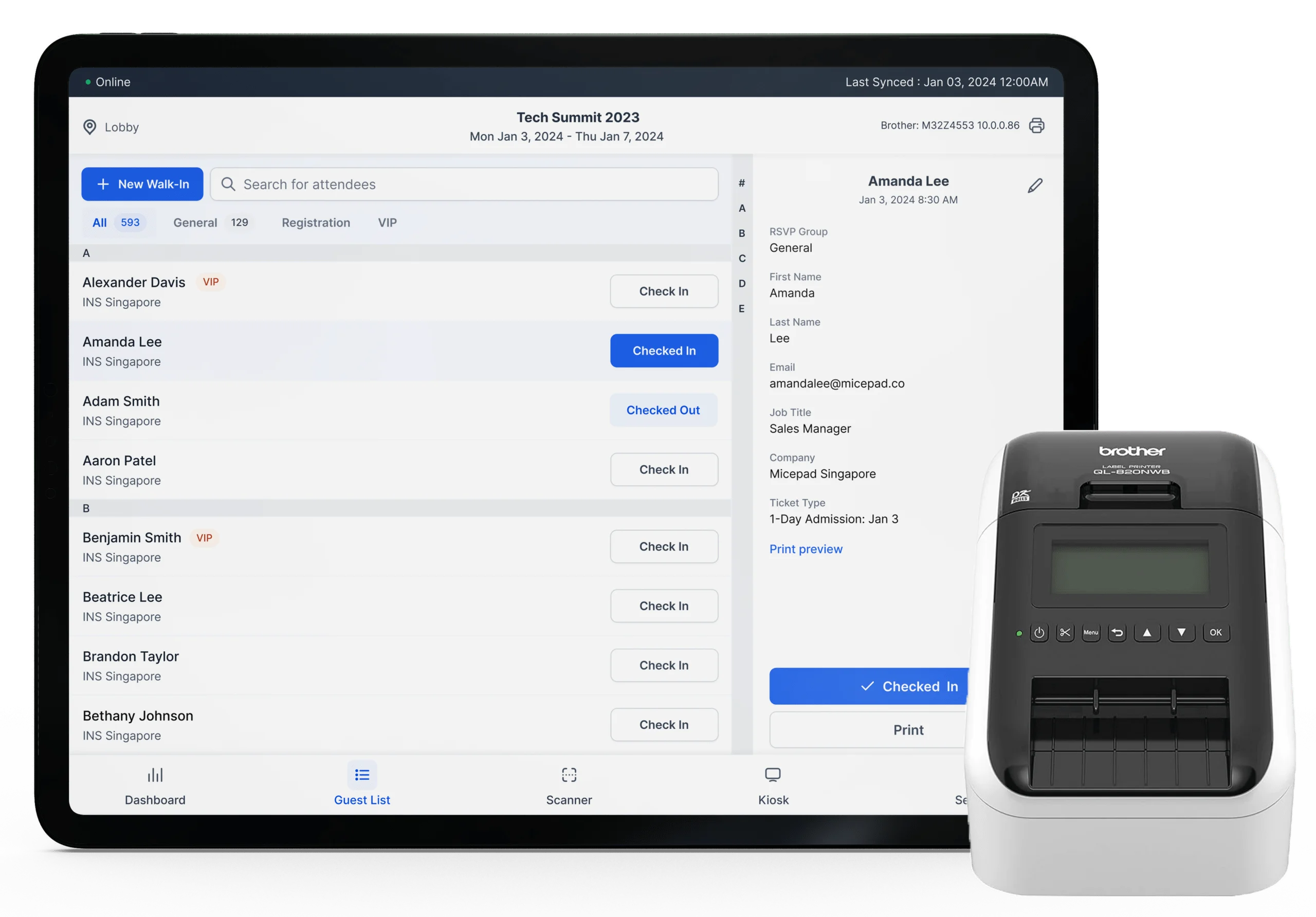
An attendee arrives and scans their QR code at a self-service kiosk or presents it to a registration staff member. The system identifies them, pulls their registration data, selects the correct badge template based on their attendee category, formats the bilingual name fields, and sends the print job to the nearest available printer. The badge is ready before the attendee has put their phone away.
For walk-in registrations, the system captures details on a tablet, creates the record, and prints the badge in the same workflow. No separate data entry step, no delay.
Micepad handles this entire flow on its platform. The badge engine supports unlimited template variations per event, automatic bilingual formatting, category-based designs, and real-time print queue management. With the platform's AI agents, the system also monitors printer status and queue distribution, rerouting print jobs if a printer runs low on supplies or develops a fault.
Getting it right
For Hong Kong event organisers, the badge printing decision comes down to a few practical questions.
Can the system handle bilingual names without manual formatting? Can it produce differentiated badges for multiple attendee tiers? Does it print fast enough for your peak arrival window? Does it capture the compliance data your clients need?
These are not luxury features. They are baseline requirements for corporate events in Hong Kong. The organisers who treat badge printing as a strategic part of the attendee experience, rather than a last-minute logistics task, consistently deliver better events.
Micepad has served over 500,000 attendees across 13 years, with badge printing as part of a wider platform used by clients including MongoDB, KPMG, and WeWork. The platform is built for the specific demands of corporate events in Hong Kong, Singapore, and Taiwan, where bilingual operations, VIP handling, and high-throughput printing are standard expectations.
Your badge is the first impression your event makes. It is worth getting right.
Designing event badges?
See how Micepad handles badge design, printing, and on-demand custom branding.